Published 11/06/2026 – est. 6 minutes to read.
In today’s increasingly connected healthcare environment
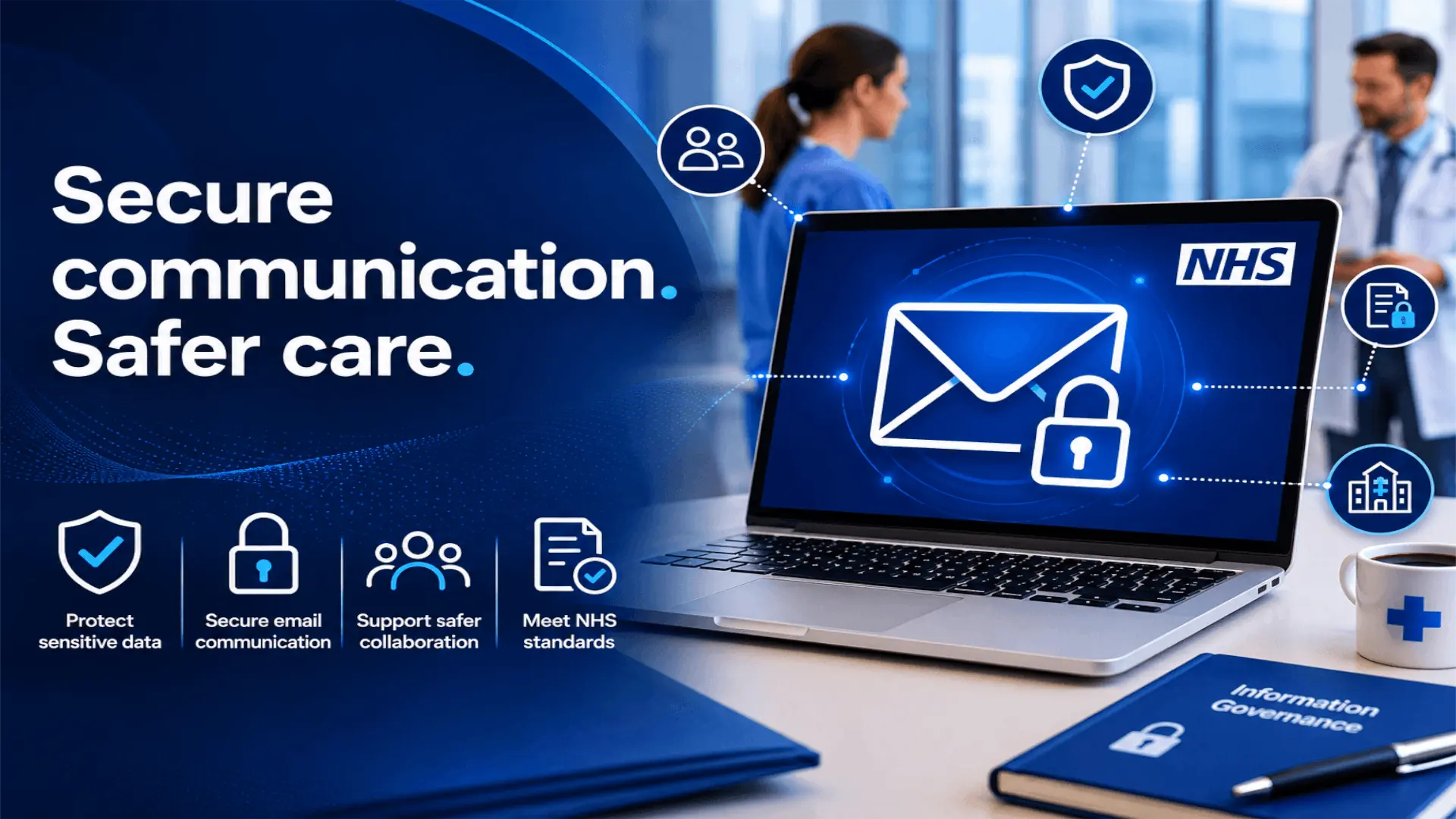
Secure communication is no longer simply an IT requirement; it’s a critical component of patient safety, data protection, and effective collaboration across the health and care system.
The NHS Secure Email Standard (DCB1596) was introduced to ensure that organisations exchanging sensitive and confidential information can do so safely and consistently. As health and social care services continue to digitise, the standard provides a clear framework for secure email communication across organisational boundaries.
The Challenge of Secure Communication
Healthcare organisations handle some of the most sensitive information imaginable. Patient records, clinical updates, referral information, safeguarding concerns, and operational communications are exchanged daily between NHS trusts, GP practices, social care providers, pharmacies, local authorities, and independent healthcare organisations.
Without a common security standard, organisations risk exposing confidential information through insecure email systems, inconsistent security controls, or poor governance processes.
The Secure Email Standard addresses this challenge by establishing minimum requirements that organisations must meet to securely exchange information electronically. Its goal is straightforward: ensure that sensitive data remains protected while enabling efficient communication across the health and care ecosystem.
What Is the Secure Email Standard?
The Secure Email Standard (DCB1596) defines the minimum security requirements that email services must meet when handling confidential and sensitive health and care information. Organisations that exchange confidential personal data are expected to comply with the standard to ensure secure transmission and the presence of appropriate governance controls.
The standard is not solely about technology. It also focuses on organisational responsibilities, including:
- Security incident reporting processes
- Staff training and awareness
- Policies governing the use of secure email
- Mobile device security
- Clinical risk management considerations
- Appropriate handling of communications with non-secure recipients
By combining technical controls with governance requirements, the standard helps organisations build a comprehensive approach to secure communication.
Two Routes to Compliance
Organisations can meet the Secure Email Standard in one of two ways.
1. Adopt an Already Compliant Service
The simplest route is to use an accredited email platform such as NHS.net Connect (formerly NHSmail), Microsoft 365, or Google Workspace configured in accordance with NHS guidance. These platforms can meet the standard’s technical requirements when implemented correctly.
For many organisations, NHS.net Connect offers a straightforward path to compliance, providing secure email, collaboration tools such as Microsoft Teams, SharePoint, and OneDrive, and multi-factor authentication.
2. Demonstrate Compliance Independently
Organisations that operate their own email infrastructure can seek accreditation by demonstrating that their service meets the requirements of DCB1596. This involves providing evidence, completing conformance assessments, and validating security controls against NHS requirements.
While this route offers greater flexibility, it also places greater responsibility on organisations to maintain and evidence compliance.
Beyond Technology: Building a Security Culture
One of the most important aspects of the Secure Email Standard is its recognition that technology alone cannot prevent data breaches.
Even with secure platforms in place, risks remain if users are unaware of how to handle sensitive information correctly. That’s why the standard requires organisations to establish policies and procedures that help staff understand how to use email safely and appropriately.
This includes guidance on:
- Sharing patient information
- Recognising secure and non-secure email domains
- Using encryption where necessary
- Managing mobile access securely
- Responding to potential security incidents
By embedding secure communication practices into everyday workflows, organisations can reduce risk while maintaining operational efficiency.
Supporting Secure Communication Beyond NHS Domains
Healthcare communication increasingly extends beyond NHS organisations. Patients, carers, partner agencies, and independent providers often use email systems that do not meet NHS security requirements.
The Secure Email Standard acknowledges this reality and requires organisations to have processes in place for safely communicating with non-secure recipients. NHSmail, for example, provides encryption capabilities that enable the secure exchange of sensitive information with external email services when appropriate safeguards are in place.
This flexibility helps organisations balance security requirements with the practical need to communicate across diverse care settings.
Why Compliance Matters
Meeting the Secure Email Standard delivers benefits beyond regulatory compliance.
Organisations that adopt secure email practices can:
- Improve trust between partner organisations
- Reduce the risk of data breaches
- Support safer information sharing
- Enable more efficient cross-organisational collaboration
- Demonstrate strong information governance practices
- Strengthen public confidence in digital healthcare services
As integrated care systems continue to expand and digital transformation accelerates, secure information exchange becomes increasingly important to delivering joined-up care.
Looking Ahead
The future of healthcare depends on the ability to share information quickly, securely, and confidently. The NHS Secure Email Standard provides a foundation for achieving this across the health and social care sector.
Whether organisations choose NHS.net Connect, Microsoft 365, Google Workspace, or their own accredited solution, the message is clear: secure communication is not optional. It is a fundamental requirement for protecting patients, supporting staff, and enabling modern healthcare delivery.
By embracing the principles of DCB1596, organisations can move beyond mere compliance and foster a culture in which secure communication supports better outcomes for everyone involved in care.
Need Help?
Whether you’re adopting NHS.net Connect, Microsoft 365, or an independently accredited solution, our team can help you navigate the requirements and implement best-practice security controls.
To evaluate your solution or discuss our other services, connect directly with our technical team:
Telephone: 0161 706 0244
Email: info@cybersecurityspecialists.co.uk
Related Pages