Skip to Content

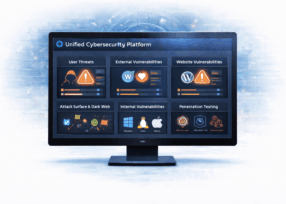
Why a Unified Cyber Security Platform is No Longer Optional

As cyber threats continue to evolve, organisations are increasingly struggling with fragmented security tools, siloed data, and limited visibility. Managing user threats, vulnerabilities, and attack surfaces across...

Learn more

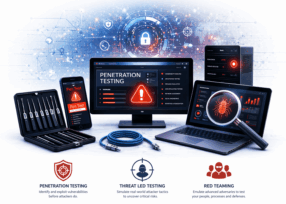
Penetration Testing, Threat-Led Testing & Red Teaming: Understanding the Differences

Cyber threats today are more sophisticated, targeted, and persistent than ever. As a result, organisations are evolving their security testing approaches beyond traditional methods. Penetration testing, threat-led...

Learn more

What is the NHS Secure Email Standard?

In today’s increasingly connected healthcare environment, secure communication is no longer simply an IT requirement it’s a critical component of patient safety, data protection, and effective collaboration...

Learn more

What Is Website Vulnerability Scanning and why is it needed?

Vulnerability scanning is a crucial step in protecting your digital assets from cyber threats. It involves automatically identifying security weaknesses such as outdated software, misconfigurations, and common...

Learn more

External Vulnerability Scanning – do I still need it?

In today’s threat landscape, attackers don’t start from the inside, they start from the outside. Your external network footprint is the first thing they see, probe, and...

Learn more

Why continuous Cloud Security Scanning Matters

As organisations rely more on cloud services like Amazon Web Services (AWS), Microsoft Azure, Microsoft 365, and Google Cloud Platform (GCP), one truth becomes clear: most cloud...

Learn more

The Importance of User Threat Monitoring: Closing the Gaps Attackers Exploit

As organisations continue to adopt cloud platforms like AWS, Microsoft 365, Azure, and Google Cloud, identity has become the new security perimeter. Firewalls and endpoint protection are...

Learn more

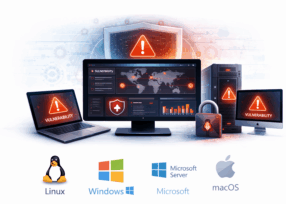
Why Continuous Vulnerability Scanning Matters Across Linux, Windows, Microsoft Server, and macOS

Vulnerabilities are discovered and exploited every day. Whether you’re running Linux, Windows, Microsoft Server, or macOS, relying on occasional scans is no longer enough.  AI is increasing both...

Learn more

What is Quantum Computing and How to prepare for Q Day

Quantum computing is an emerging technology that uses the principles of quantum mechanics to process information in fundamentally different ways from traditional computers. While classical computers use...

Learn more

Cyber Essentials 2026 updates: Danzell Question Set and What you need to know

The National Cyber Security Centre (NCSC) and IASME have released their latest round of updates to Cyber Essentials. The revised requirements will apply to all assessments created...

Learn more
abstract image of a brain and a computer chip

Anatomy of a Penetration Test Part 2: Web Applications

Anatomy of a Penetration Test Part 2: Web Applications A web application security assessment is a type of penetration test that seeks to find vulnerabilities in a...

Learn more

IASME Cyber Assurance Version 7 Released

IASME Cyber Assurance Version 7 Released The first version of the IASME Cyber Assurance certification was introduced in 2012 and initially known as the IASME Governance standard....

Learn more