Published 29/08/2026 – est. 6 minutes to read.
A Complete Guide to Protecting Payment Data
In today’s digital-first economy, accepting card payments is fundamental to business growth. However, as transaction volumes continue to surge, payment card data remains one of the primary targets for cybercriminals globally. Whether you are an e-commerce startup, a multi-site retailer, or an enterprise service provider, safeguarding cardholder data is not just a regulatory obligation; it is essential to maintaining customer trust and protecting your brand reputation.
The Payment Card Industry Data Security Standard (PCI DSS) serves as the global security benchmark designed to prevent payment fraud and secure sensitive financial environment data.
In this guide, we break down what PCI DSS is, explain its twelve core requirements and six foundational principles, highlight key updates in PCI DSS v4.0, and outline how your organisation can achieve and keep seamless compliance.
What is PCI DSS?
The Payment Card Industry Data Security Standard (PCI DSS) was established by major payment card brands, including Visa, Mastercard, American Express, Discover, and JCB, and is administered by the PCI Security Standards Council (PCI SSC).
Compliance is mandatory for any entity that stores, processes, or transmits Cardholder Data (CHD) or Sensitive Authentication Data (SAD). As detailed by industry security resources such as Fortinet, PCI DSS applies regardless of transaction volume, from micro-merchants to international payment gateways.
Not maintaining compliance can lead to severe consequences, including:
- Substantial monthly non-compliance fines from acquiring banks.
- Increased transaction processing fees.
- Devastating legal liabilities and forensic audit costs in case of a breach.
- Revocation of your ability to accept card payments.
- Irreparable reputational damage.
The 6 Guiding Principles of PCI DSS
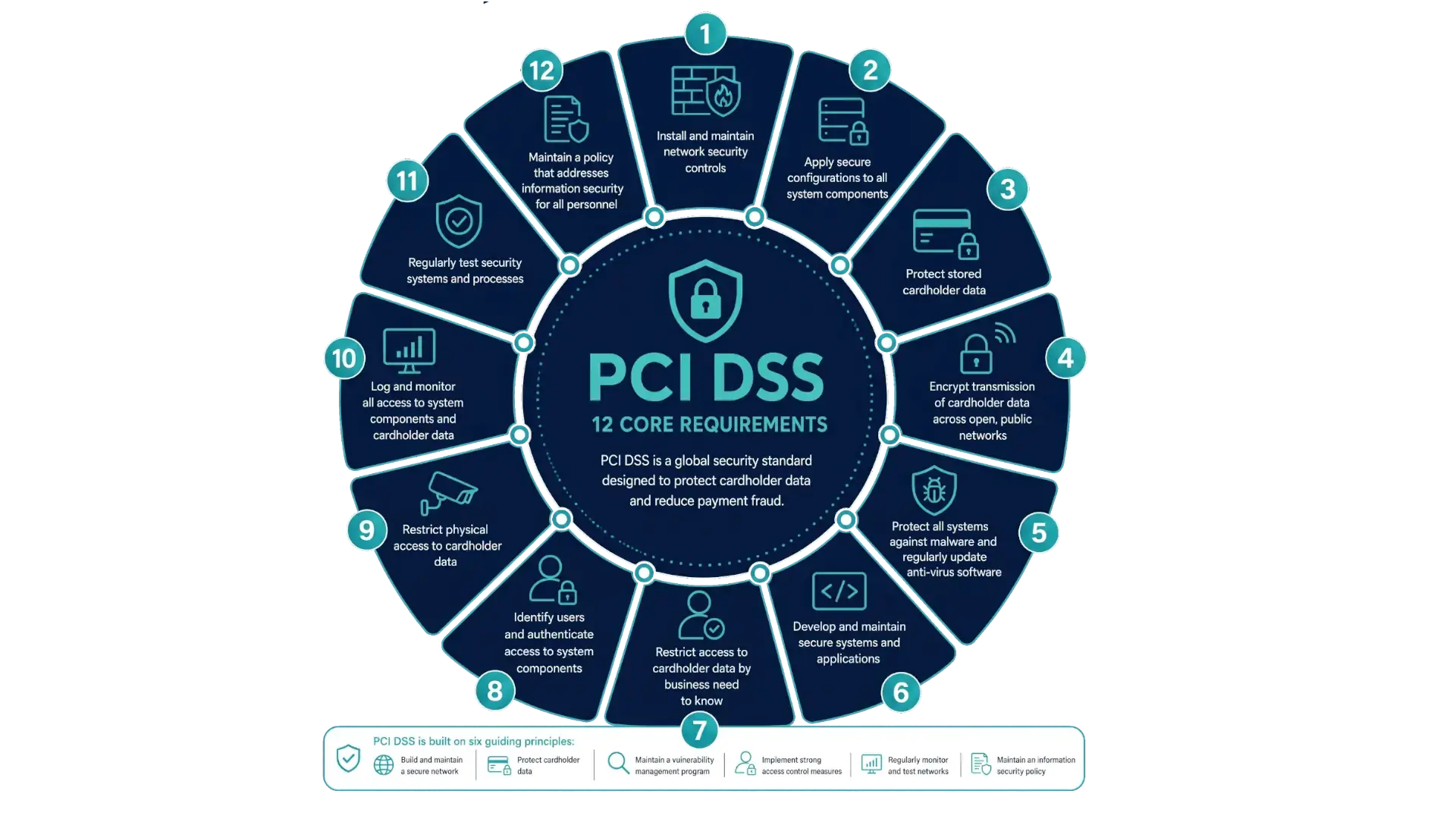
PCI DSS is structured around six core goals that form the foundation of a robust payment security posture:
1) Build and Maintain a Secure Network and Systems: Ensure all networks, firewalls, and system components are architected and configured securely.
2) Protect Cardholder Data: Safeguard primary account numbers (PAN) and authentication details both in transit and at rest.
3) Maintain a Vulnerability Management Program: Implement proactive anti-malware protections and patch management systems to shield against emerging threats.
4) Implement Strong Access Control Measures: Enforce least-privilege principles, restricting physical and logical access to payment infrastructure.
5) Regularly Monitor and Test Networks: Continuously track user access, audit system events, and conduct rigorous penetration testing.
6) Maintain an Information Security Policy: Show clear operational policies, security awareness training, and governance across all personnel.
The 12 Core Requirements of PCI DSS Explained
Underneath these six guiding principles lie the 12 Core Requirements that every merchant and service provider must implement:
Goal 1: Build and Maintain a Secure Network
- Requirement 1: Install and claim network security controls. Deploy network security controls (such as next-generation firewalls) to control traffic flow between the Cardholder Data Environment (CDE) and untrusted networks.
- Requirement 2: Apply secure configurations to all system components. Eliminate vendor-supplied default passwords and security parameters across all hardware, operating systems, and applications prior to deployment.
Goal 2: Protect Cardholder Data
- Requirement 3: Protect stored cardholder data. Minimise cardholder data retention to what is strictly necessary. Encrypt, truncate, or tokenise Primary Account Numbers (PAN) at rest, and never store post-authorisation sensitive authentication data (SAD).
- Requirement 4: Encrypt transmission of cardholder data across open, public networks. Use strong cryptography and security protocols (such as TLS 1.2 or TLS 1.3) whenever payment data is transmitted across public networks or untrusted wireless channels.
Goal 3: Support a Vulnerability Management Program
- Requirement 5: Protect all systems against malware and regularly update antivirus software. Deploy Endpoint Detection and Response (EDR) or anti-malware tools to detect, quarantine, and remediate malicious software across all system components.
- Requirement 6: Develop and support secure systems and applications. Implement a secure Software Development Lifecycle (SDLC), apply critical security patches, and protect web applications against common web vulnerabilities such as SQL injection and cross-site scripting (XSS).
Goal 4: Implement Strong Access Control Measures
- Requirement 7: Restrict access to cardholder data by business need-to-know. Enforce strict Role-Based Access Control (RBAC), ensuring personnel are granted only the minimum privileges needed to perform their job duties.
- Requirement 8: Show users and authenticate access to system components. Assign a unique ID to every user and enforce Multi-Factor Authentication (MFA) for all access to the Cardholder Data Environment.
- Requirement 9: Restrict physical access to cardholder data. Protect data centres, server rooms, and physical Point of Sale (POS) terminals using electronic access controls, visitor logging, and tamper-detection inspections.
Goal 5: Regularly Monitor and Test Networks
- Requirement 10: Log and watch all access to system components and cardholder data. Centralise event logging, synchronise clocks using network time protocols, and routinely review audit trails to detect suspicious or unauthorised activities.
- Requirement 11: Regularly evaluate security systems and processes. Conduct quarterly external and internal vulnerability scans, routine wireless analyser checks, and annual CREST-accredited penetration testing.
Goal 6: Keep an Information Security Policy
- Requirement 12: Support a policy that addresses information security for all personnel. Establish comprehensive information security policies, mandate annual staff security awareness training, manage third-party service provider risks, and keep a tested Incident Response Plan.
What’s New in PCI DSS v4.0?
The transition to PCI DSS Version 4.0 reflects the evolving threat landscape and modern technology environments (such as cloud computing, serverless architectures, and APIs).
Key highlights include:
- Focus on Continuous Compliance: PCI DSS 4.0 moves organisations away from an annual “tick-box” exercise toward ongoing, real-time security monitoring.
- Enhanced Authentication Requirements: Multi-Factor Authentication (MFA) is now needed for all access to the Cardholder Data Environment, not just administrative logins.
- Customised Implementation Approach: Organisations now have the choice to meet security goals via a customised approach, offering flexibility for novel security controls, provided they achieve equivalent security outcomes.
- Targeted E-Commerce Security: Stricter requirements have been introduced to combat e-commerce skimming attacks (such as Magecart) through script monitoring and payment-page integrity checks.
How to Achieve & Keep PCI DSS Compliance
Achieving PCI DSS compliance requires a systematic, structured approach:
1) Scope Reduction: Find all payment flows and isolate your Cardholder Data Environment using network segmentation and tokenisation to dramatically lower audit effort and overheads.
2) Gap Analysis: Evaluate existing technical controls, policies, and procedures against the twelve requirements to uncover compliance gaps.
3) Remediation: Implement necessary network changes, update software configurations, apply patches, and refine security documentation.
4) Assessment & Validation: Complete a Self-Assessment Questionnaire (SAQ) or engage a Qualified Security Assessor (QSA) for an Attestation of Compliance (AOC).
5) Continuous Maintenance: Conduct quarterly vulnerability scans, perform annual penetration tests, check log activity daily, and deliver ongoing staff security training.
How Cyber Security Specialists Can Help
Navigating payment card compliance does not have to be complex or overwhelming. At Cyber Security Specialists, we deliver pragmatic, cost-effective security and compliance solutions that protect your infrastructure while streamlining the audit process.
Our team of certified security consultants provides comprehensive support tailored to your business:
- PCI DSS Gap Assessments & Scope Optimisation: Show existing gaps, reduce your compliance scope, and build a clear remediation roadmap.
- CREST-Accredited Penetration Testing: Fulfil Requirement 11 with thorough external, internal, and web application penetration tests.
- Vulnerability Management & Scanning: Automated scanning solutions to help support continuous oversight of your internal and external assets.
- Policy Frameworks & CTaaS (Cyber Team as a Service): Dedicated cybersecurity ability to manage policies, risk assessments, and compliance management on an ongoing basis.
Ready to Simplify Your PCI DSS Compliance?
Whether you need help scoping your Cardholder Data Environment, conducting mandatory penetration testing, or preparing for an upcoming audit, our team is here to guide you every step of the way.
Are you ready to simplify your PCI DSS Compliance? Connect directly with our technical team:
Telephone: 0161 706 0244
Email: info@cybersecurityspecialists.co.uk
Related Pages